
Some time has passed, but my first AMUG definitely lived up to the hype.
It was great catching up with familiar faces and meeting new ones, but the real value was the learning. One of my biggest takeaways came from the keynote by Steve Fournier of General Atomics Aeronautical Systems, Inc. and Scott Sawyer of Divergent Technologies.
Not because of the technology itself - but because of how they approached adoption.
When Additive Becomes a Pitch
-
Most additive manufacturing conversations start the same way:
-
Features
-
Benefits
-
Design freedom
-
Part consolidation
-
Speed
Every company and every machine have something that stands out. Don’t get me wrong, that’s valuable. But these are also the easiest things to talk about. They’re not the conversations that change a business.
A Different Starting Point
What stood out here was simple: They didn’t start there. Instead, they started by challenging the idea itself. Divergent had already proven their additive-driven, software-defined manufacturing model in automotive. Their platform integrates:
-
Design software
-
Additive production
-
Automated assembly
All within a fully digital manufacturing system.
Expanding Into Aerospace - Without Assumptions
The next step was expanding into aerospace and defense through their partnership with GA-ASI, specifically around unmanned aircraft systems.
On paper, it made perfect sense:
-
Lightweight structures
-
Complex geometries
-
Performance-driven design
All strong fits for additive.
But they didn’t assume it would translate.
They Pressure Tested It
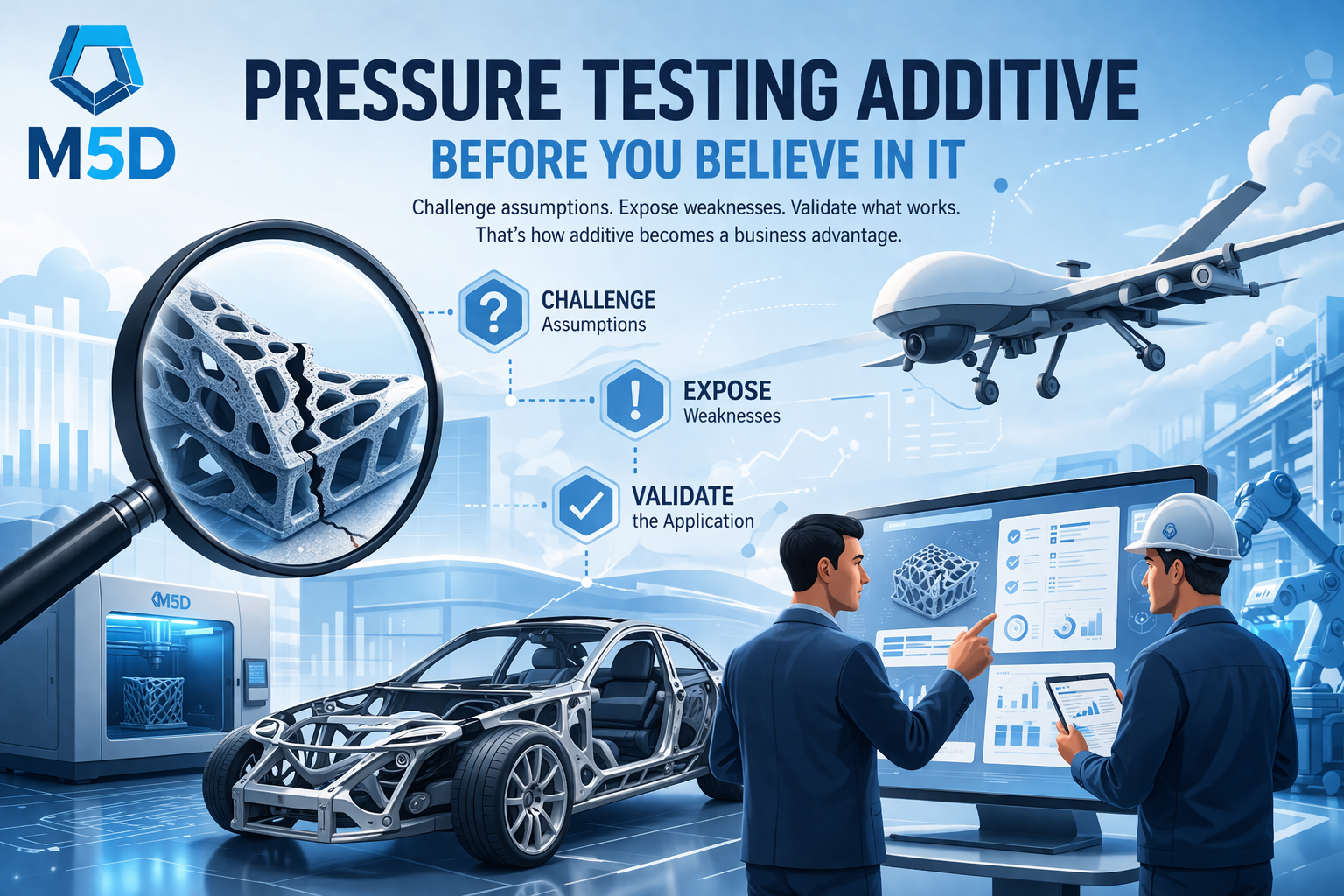
Instead of building a case for why additive should work…They focused on where it might break.
They asked:
-
What carries over from automotive?
-
What doesn’t translate?
-
What still needs development?
-
Where does the process fall short under new demands?
Because aerospace brings:
-
Different requirements
-
Different risk tolerance
-
Different qualification standards
-
Different expectations for performance and reliability
The Mindset Shift
-
From selling the technology → to validating the application
-
From proving upside → to exposing risk
-
From excitement → to discipline
This is where additive stops being interesting…and starts becoming business-critical.
Where Projects Actually Succeed (or Fail)
This approach forces a deeper level of thinking:
-
Beyond the machine → into the workflow
-
Beyond a single part → into repeatability
-
Beyond a pilot → into production
It does three things:
-
Challenges assumptions early
-
Aligns teams faster
-
Prevents investment in solutions that won’t scale
Because this is where most additive initiatives either gain traction or quietly stall out.
The Questions That Actually Matter
It’s easy to find parts that look like a good fit:
-
Consolidated designs
-
Reduced assembly
-
Lightweighting
But that’s just the starting point.
The real questions come after:
-
Can the material meet long-term requirements?
-
Can the process support production volumes?
-
Does post-processing become a bottleneck?
-
Will teams actually adopt and design for it properly?
-
Can the business support it beyond a pilot phase?
If those answers are unclear…The project is already at risk.
Pressure Testing Isn’t Negative, It’s Necessary
This level of scrutiny isn’t pessimistic. It’s strategic.
-
If the idea fails early, you save time, money, and resources
-
If it survives, you move forward with something that can scale
How We Approach It at M5D
At M5D, this is how we approach additive:
-
·Not just where it fits
-
But where it holds up under real conditions
-
Not just what it can do
-
But what it can’t
Because the goal isn’t to force additive into the process.
The Real Goal
The goal is to find where it actually works and build from there.
That’s what drives real adoption.
Not hype. Not features.
But applications that survive the test.
Evaluate Where Additive Actually Works
If you're exploring additive manufacturing, the biggest risk isn’t choosing the wrong machine—
it’s moving forward without validating the application.
At M5D, we help teams pressure test additive before they invest.
Schedule an Additive Assessment here, Zach Carr
Zach Carr
zcarr@m5d.com
(312) 982.426